
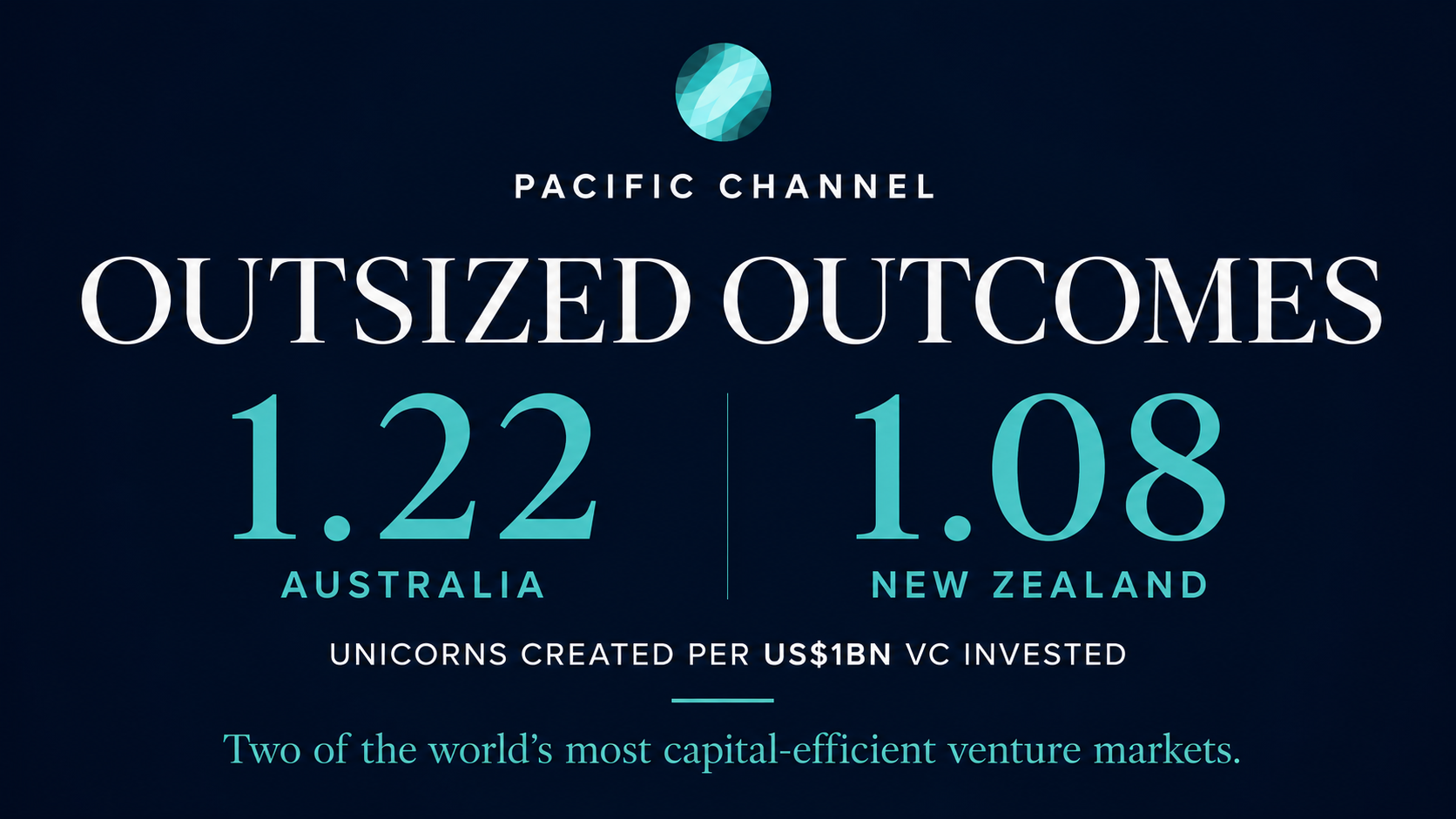
Australia and New Zealand are creating billion-dollar outcomes on a fraction of the capital available in larger venture markets.
While Australia and New Zealand are often viewed as relatively small venture capital markets, when measured by their ability to create value relative to capital invested, both countries consistently rank among the strongest performers globally.
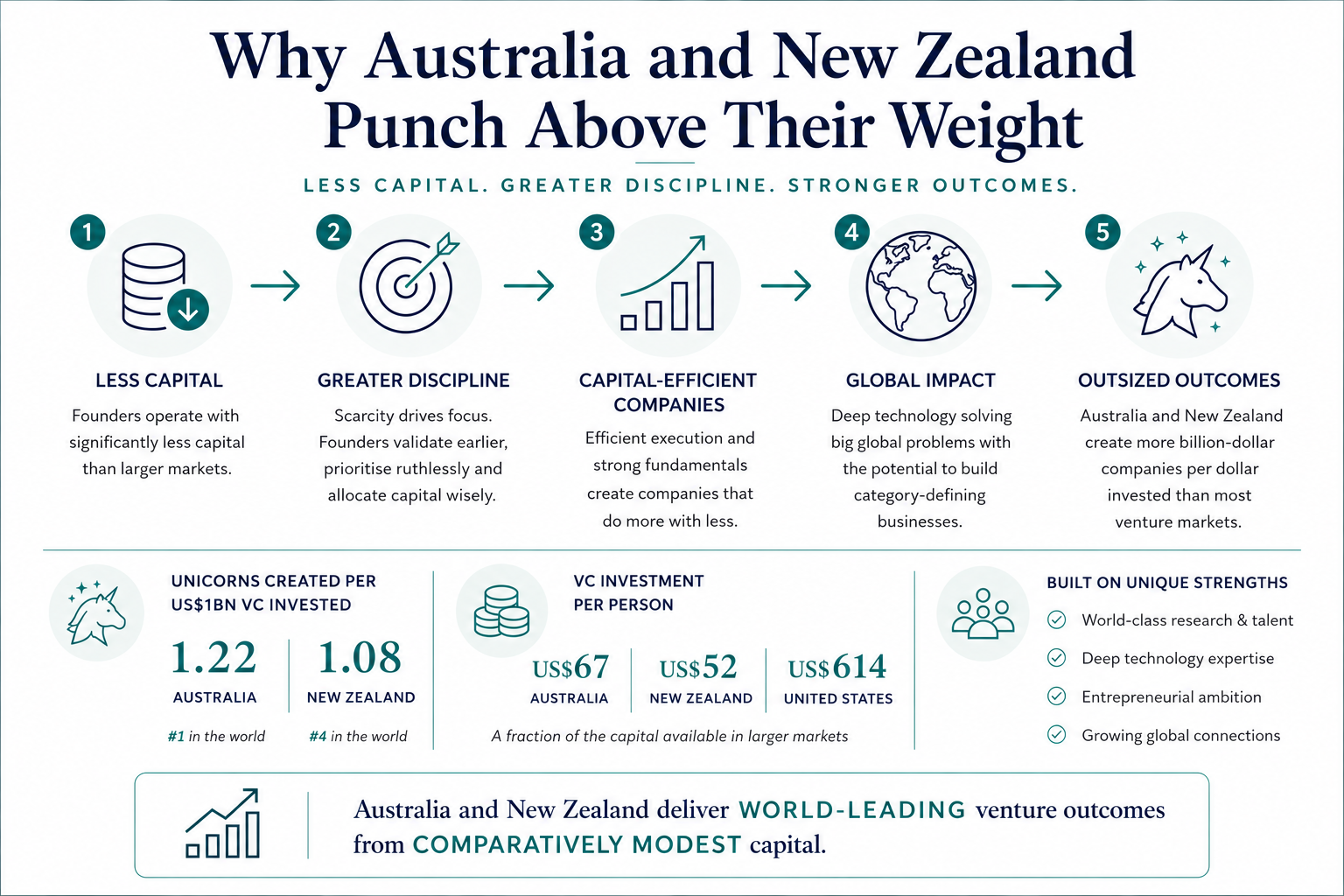
Australia currently produces 1.22 unicorn companies for every US$1 billion of venture capital invested, the highest ratio in the world. New Zealand ranks fourth globally at 1.08 unicorns per US$1 billion invested. On this measure, both countries rank alongside, and in some cases ahead of, much larger and more established venture markets.
What makes these numbers particularly significant is the amount of capital available to founders.
Venture capital investment in the United States equates to approximately US$614 per person. In Australia the figure is approximately US$67 per person, while in New Zealand it is approximately US$52.
Taken together, these numbers tell an important story.
Australia and New Zealand are creating world-leading venture outcomes despite operating with significantly less capital than many of their global peers. For investors, this raises an important question. Why are Australia and New Zealand producing such strong outcomes relative to the capital invested?
While there is no single explanation, one factor is particularly significant. Founders in Australia and New Zealand have historically built companies in environments where capital has been available, but rarely abundant. As a result, businesses have often been required to achieve meaningful technical, commercial and market milestones with fewer resources than would typically be available in larger venture markets.
This reality shapes company-building behaviour. Founders are required to validate assumptions earlier, focus on achieving product-market fit, prioritise capital allocation and build teams carefully. Over time, these characteristics have contributed to a culture of capital discipline and efficient execution that is reflected in the performance of the broader venture ecosystem.
Why are Australia and New Zealand producing such strong outcomes relative to the capital invested?
For investors, this matters because capital efficiency is not simply a feature of individual companies. It has become a characteristic of the market itself. The ability to create significant enterprise value from comparatively modest levels of investment is one of the reasons Australia and New Zealand continue to produce outsized outcomes relative to the capital deployed.
Pacific Channel has spent more than twenty years investingin companies emerging from this environment and has seen first-hand how capital discipline, strong science and global ambition can create businesses capable ofcompeting on the global stage.
This dynamic is particularly relevant in deep technology, where long development cycles and complex technical challenges demand both patience and disciplined capital allocation. Unlike many software businesses, deep technology companies often require years of research, validation and commercial development before reaching scale. In these environments, capital efficiency becomes more than a financial metric - it can become a competitive advantage.
Many of the most significant opportunities in venture investing are focused on addressing complex global challenges in healthcare, food production, climate technologies, industrial productivity and advanced manufacturing. Australia and New Zealand's deep-tech companies are typically built on years of scientific research, proprietary technology and highly specialised expertise. While they often operate in markets measured in billions of dollars, they begin life far from the major venture capital centres of theworld.
Since 2004, Pacific Channel has focused on identifying deeptechnology companies with the potential to solve globally significant problemsand supporting them through the critical stages of commercialisation andgrowth. Over that period, the firm has invested in 79 companies (to date) and achieved 11 successful exits across health, food and environmental technologies.
These outcomes have reinforced a belief that some of the most compelling venture opportunities are not always found in the largest markets. They are often found where strong science, entrepreneurial ambitionand disciplined capital come together to create businesses capable of competingon the global stage.
Several structural trends are now strengthening that opportunity.
Across the world, demand is growing for technologies that improve healthcare outcomes, strengthen food security, increase resource efficiency, reduce emissions and support the energy transition. These are not short-term trends. They are long-term global challenges that will require innovation, new technologies and significant investment to address.
Australia and New Zealand are well positioned to contribute solutions.
The region benefits from internationally recognised research institutions, strong engineering and scientific capability, experienced founders and a growing network of investors who understand the unique requirements of deep technology businesses. Increasingly, companies are also able to access international customers, strategic partners and global capital at much earlier stages of their development.
Yet despite these strengths, the region remains relatively undercapitalised compared with larger venture markets.
For investors, this creates an opportunity. Australia and New Zealand are already producing world-leading outcomes relative to the capital invested. Additional capital has the potential to support more companies through the journey from innovation to global scale.
That opportunity is particularly relevant in deep technology, where the pathway from breakthrough science to commercial success often requires patient capital, specialist expertise and a long-term perspective.
At Pacific Channel, this belief underpins our investment strategy. We continue to see a strong pipeline of founders and technologies emerging from Australia and New Zealand that have the potential to create meaningful global impact and deliver attractive investment returns. Today, Pacific Channel provides investors with access to a pipeline of deep technology opportunities emerging from Australia and New Zealand, while leveraging an expanding Asia-Pacific network to support growth and commercialisation.
The venture capital industry often focuses on the size of markets and the amount of capital deployed. Ultimately, however, the most important measure is the ability to create value from every dollar invested.
On that measure, Australia and New Zealand continue to punch above their weight.
For investors seeking exposure to deep technology, globally relevant innovation and capital-efficient growth, Australia and New Zealand continue to represent one of the most compelling and underappreciated venture opportunities in the world.
