
When someone has a stroke, every minute matters.
Doctors need to act quickly, but first they must establish precisely what type of stroke they are dealing with – ischaemic, caused by a blocked blood vessel, or haemorrhagic, caused by bleeding in the brain. Getting that diagnosis right is critical, because the treatments are very different.
The challenge is that the imaging needed to make those decisions quickly is usually located in a dedicated part of the hospital. The patient has to be taken to the scanner, the scan completed and the results assessed before the right treatment can begin.
Wellumio is working to change that.
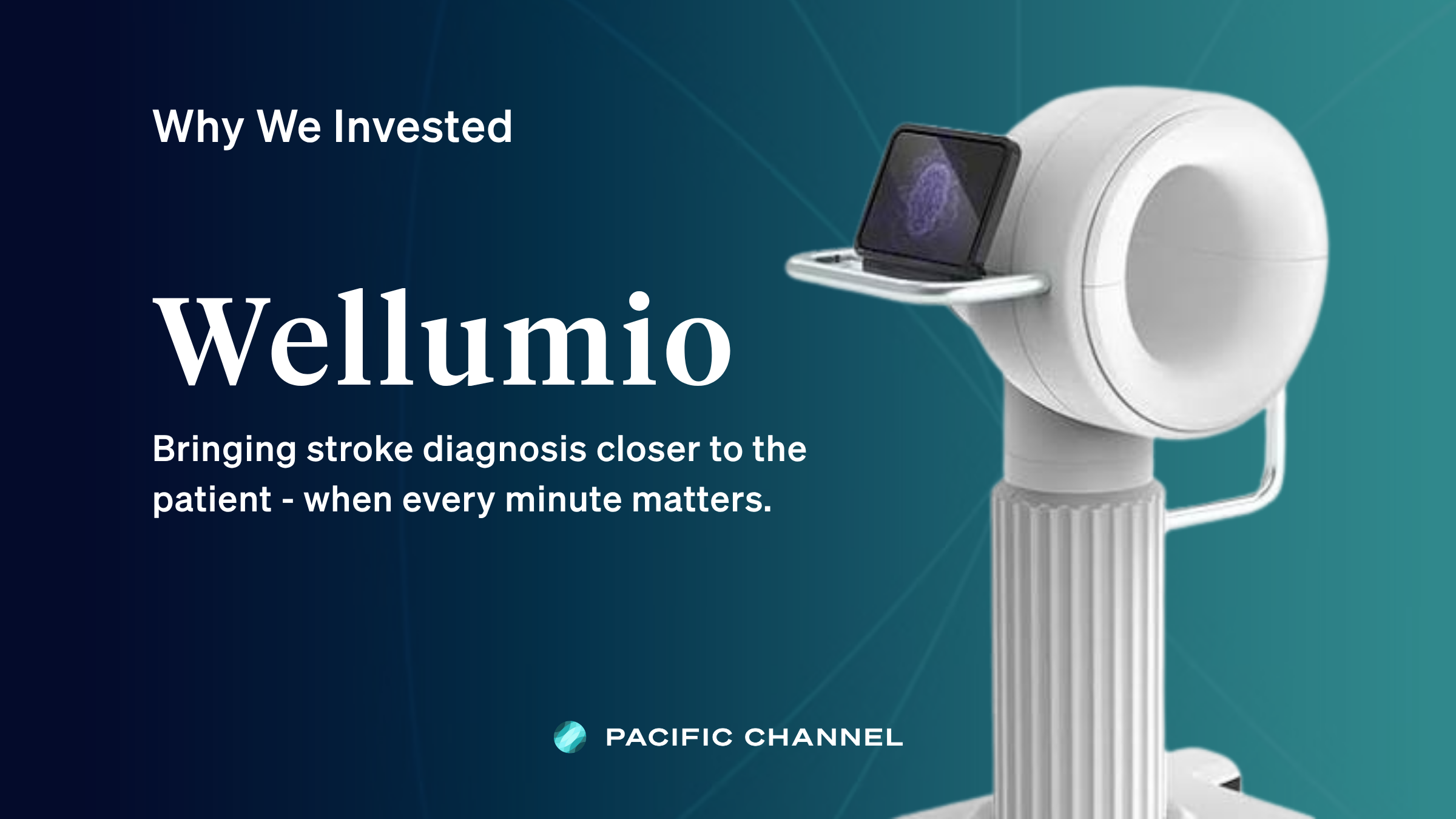
The New Zealand company has developed Axana, a portable brain scanner designed to bring advanced stroke imaging to the patient, rather than taking the patient to the scanner.
It is a simple idea with potentially significant consequences.
Why we became interested
As part of our due diligence, we spent time at Royal Melbourne Hospital where Axana was being trialled and talked to clinicians about the technology and the realities of treating stroke. That helped us understand both the challenge and the potential of Wellumio’s approach.
Axana is designed to operate at the patient's bedside, reducing the time between stroke, accurate diagnosis and the right treatment. Because of its portability, there’s the potential to use the technology in other settings including moving diagnosis closer to the point where a stroke patient first receives care i.e. ambulances or community clinical settings.
A natural question is why does this matter?
CT scanners are already an important part of acute stroke diagnosis and can quickly identify bleeding in the brain, but they cannot match the depth of an MRI’s analysis, particularly for haemorrhagic stroke, where MRI can define the size, location and nature of a bleed – including micro-bleeds and micro-aneurysms..
However, access to conventional MRI can take longer and requires an acutely unwell stroke patient – often disoriented, distressed or unstable – to be transported to a dedicated MRI suite - a journey that is as painful and difficult for the patient as it is slow for the hospital.
This is where we saw the potential for Axana. Rather than trying to replace every function of an MRI. Wellumio is developing a portable system designed to provide the same gold-standard MRI-quality information immediately at the bedside, at the exact moment treatment decisions are made.
This is not simply about optimising or speeding up the existing diagnostic pathway – it changes the outcome for the patient
The significance isn't simply that the scanner is smaller or more portable. It is what clinicians could do differently if that information was available sooner and closer to the patient.
Research has shown that treating a stroke patient earlier can make a substantial difference to their recovery.
For the patient, this can mean a better chance of recovery and independence. For the healthcare system, better outcomes can mean less time in hospital, less rehabilitation and lower long-term care costs.
Starting with a clear problem
While the technology could ultimately have applications beyond stroke, including other neurological conditions, the team started with a problem where the need is clear, the market is global and speed can make an enormous difference.
Instead of developing technology and then searching for a problem to solve, the Wellumio team started with the patient and are asking a much more useful question: how can we get doctors the information they need sooner?
This thinking is reflected in the development of Axana. Instead of trying to replace everything a conventional MRI scanner does, Wellumio has focused on developing a device specifically suited to the information clinicians need when assessing stroke.
Building for where you want to end up
At Pacific Channel, we talk about starting with the exit in mind. But for us, that doesn't mean building a company simply to sell it, it means understanding what will ultimately make a business valuable globally and making decisions early that move it towards that goal.
Wellumio understands that developing world-class technology is only part of the job. The team is thinking about the clinical evidence it will need, regulatory approval, how Axana will fit into hospitals, how it can be manufactured at scale and how the company can ultimately reach international markets.
Wellumio recently completed an oversubscribed NZ$9.75m funding round, bringing Australian and US specialist investors into the company alongside Pacific Channel. It is another important step towards building the international expertise and relationships required to take a New Zealand-developed medical technology to the world.
Why we invested
We invested in Wellumio because it combines something we consistently look for: a big challenge, genuinely differentiated technology and a team with the focus and ambition to build a global business around it.
While there is still plenty of work ahead (that is the nature of investing in deep technology), the fundamental proposition is remarkably simple.
Today, a stroke patient is taken to the scanner. Wellumio wants to bring the scanner to the patient.
And when every minute matters, that could make a very significant difference – not just a faster result, but, in many cases, a different and better outcome for the patient.
